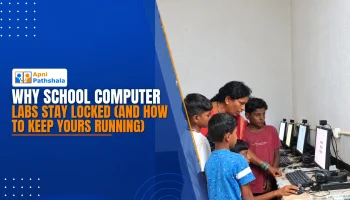
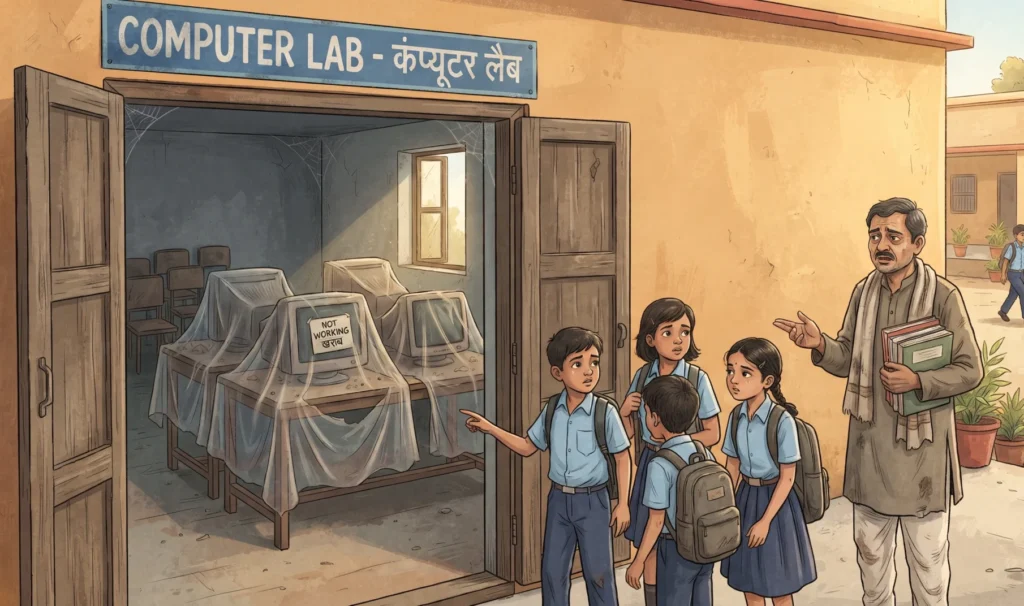
Ask a Class 10 student in a small town what a computer period looks like, and you may hear the same story. A room has a sign that says Computer Lab. The door is usually locked. The machines sit under plastic covers. In the weeks before board exams, the period quietly turns into a maths revision class.
On paper, that student’s school has a computer. In practice, they may finish school without ever typing a full page, saving a file or making a slide.
This is not a few unlucky children. Government data released in July 2026 shows that only about one in three Indian schools has a working desktop computer for students. In government schools, where roughly half of India’s children study, it is one in four. That is how lakhs of students still finish school without real time on a computer, in a country that talks every day about AI and Digital India.
Here is what the numbers say, why phones aren’t closing the gap, and what is starting to work on the ground.
How Many Indian Schools Have Computers? What UDISE+ 2025-26 Shows
UDISE+ is the Ministry of Education’s yearly census of every school in India. The 2025-26 round covers 14.67 lakh schools and about 24.7 crore students. Its figures on computer access in schools look better than they did a few years ago, until you read them closely.
| UDISE+ 2025-26 measure | Share of all schools |
| Has some computer facility | 69.9% |
| Has internet | 67.4% |
| Has a working desktop or PC | 36.5% |
| Has a smart classroom | 33.9% |
The headline number has climbed fast. In 2022-23, only 47.7% of schools reported any computer. By 2024-25, that was 64.7%, and now it is close to 70%.
But the line that matters for a student is the third one. Just 36.5% of schools have a desktop or PC that actually works. That leaves roughly 9.3 lakh schools where a child has no working machine to sit at.
A Computer Lab on Paper Is Not a Child at a Keyboard
Why is there such a big gap between 70% and 36.5%? Because “computer facility” can mean a single machine in the office for attendance and records. It can mean a lab set up under a scheme years ago that hasn’t worked since the UPS died.
Anyone who has visited a few schools in Tier 2 and Tier 3 India knows the reasons labs go quiet:
- No one to teach. The computer teacher post is vacant, or one teacher covers 400 students.
- No one to fix it. A broken keyboard or a virus can shut a machine down for months.
- Fear of damage. Labs stay locked because the school will be blamed if something breaks.
- No time. Computer periods are the first to go when the syllabus or exams are behind.
So a student can attend a school that “has computers” for ten years and still never get their own 40 minutes at a keyboard. This is the hidden part of the digital divide in Indian schools: it is less about owning machines and more about children actually using them.
Government vs Private Schools: Where the Digital Divide Is Widest
The gap is not spread evenly. It falls hardest on the children who already have the least.
| UDISE+ 2025-26 | Government schools | Private unaided schools |
| Some computer facility | 66.9% | 80.0% |
| Working desktop or PC | 25.5% | 63.2% |
| Internet | 63.1% | 79.2% |
A child in a private school is about two and a half times more likely to have a working desktop than a child in a government school. And government schools teach roughly half of all students in India.
Geography widens it further. In Meghalaya, only 13.8% of schools have a working desktop. Assam is at 16.6%, Bihar at 17.7%, Madhya Pradesh at 20.9%, and Uttar Pradesh at 22%. Uttar Pradesh and Bihar alone have some of the largest school populations in the country, so these low percentages translate into very large numbers of children.
Why Smartphones Are Not Filling the Gap

A fair question: don’t most teenagers already have phones? They do. ASER 2024, Pratham’s survey of about 6.5 lakh rural children, found that 84% of rural households now have a smartphone, and 82% of 14- to 16-year-olds know how to use one. Most could find a YouTube video, browse for information and set an alarm.
That is real progress. But it is a different skill set. ASER’s digital section tested smartphones, not computers, and for good reason: that is the device rural teens actually hold.
A phone teaches you to watch, scroll, search and share. It rarely teaches you to type 500 words, format a table, build a spreadsheet, attach a file to an email or write a line of code. Those are exactly the skills that college, competitive exams and first jobs assume a student already has. So a teenager can be confident on Instagram and still freeze in front of a keyboard.
What Finishing School Without Computer Skills Costs a Student
The cost doesn’t show up on a marksheet. It shows up in the first few weeks after school ends.
- The first college assignment. It has to be typed and emailed, and the student is figuring out how to save a file the night before it is due.
- The online form. Admissions and scholarship forms are filled out at a cyber cafe, by someone else, for a fee. A wrong entry can cost a seat.
- The computer-based test. Many entrance and recruitment exams are now taken on a computer. A student who has never used a mouse loses minutes just learning to navigate the screen.
- The interview. “Do you know Excel?” is an easy question for some and a quiet panic for others.
None of this is about intelligence. It is about who got practice and who didn’t. That is why basic digital literacy now matters as much as reading and maths: it decides how easily a student can use everything else they know.
How Communities Are Closing the Gap
Waiting for every school to get a working lab could take another decade. So some of the most useful work is happening outside school walls, in places children can walk to.
- Shared labs. Schools without a lab send students to a nearby centre for regular sessions, so they can still build digital skills even before their own lab exists.
- NGO and CSR programmes. Organisations fund computers and, just as important, a person to run them.
- Neighbourhood learning centres. A small room, a few computers and a trained local mentor, open after school hours.
Apni Pathshala’s PODs are built on that last idea. Each POD is a community learning centre where children get regular, hands-on computer time with a mentor who keeps the machines running and the sessions going. Students start with the basics, like typing their name and saving a file, and move on to real projects.
We captured what that first-computer moment looks like in a short Instagram carousel. See the carousel on Instagram
What Parents, Teachers and Changemakers Can Do
The UDISE+ numbers will keep improving, slowly. A student in Class 9 today does not have that long. Here is what each of us can do this year:
- If you are a parent: don’t just ask whether the school has a lab. Ask when your child last used it, and for how long.
- If you run or teach in a school: start small rather than wait for a perfect lab. Even 5 working computers and a fixed timetable change things. Our step-by-step guide to setting up a computer lab in school shows how.
- If you lead an NGO, a company or a community group, fund or host a learning centre so the next first-time computer user is 10 years old, not 18.
Help bring computers to more students. Partner with Apni Pathshala.
Frequently Asked Questions
1. What percentage of Indian schools have computers?
Ans. According to UDISE+ 2025-26, 69.9% of schools report some computer facility, but only 36.5% have a working desktop or PC that students can use. In government schools, the figure for a working desktop is 25.5%.
2. Which states have the fewest schools with computers?
Ans. Meghalaya (13.8%), Assam (16.6%), Bihar (17.7%), Madhya Pradesh (20.9%) and Uttar Pradesh (22%) have the lowest share of schools with a working desktop, as per UDISE+ 2025-26.
3. Is a smartphone enough to learn computer skills?
Ans. Not fully. A phone helps with searching, watching and sharing, but skills like typing, spreadsheets, presentations and coding are learned best on a computer with a keyboard.
4. What is the digital divide in Indian schools?
Ans. It is the gap between students who get regular, hands-on access to computers and the internet and those who don’t. In India, it runs along lines of school type (government vs private), state and rural vs urban..